
Your procurement team negotiated strong contracts this year. Savings were logged. Suppliers were consolidated. The quarterly review looked good.
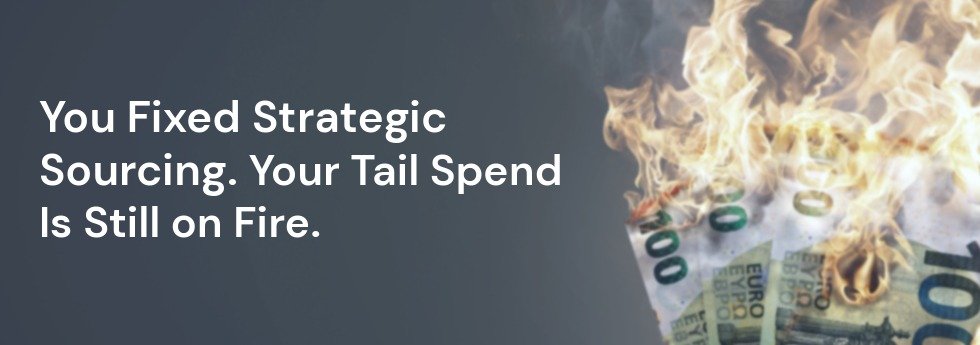
Meanwhile, somewhere between 15 and 30 percent of your organization’s actual spend went through none of it.
No approved supplier. No negotiated rate. No procurement visibility. Just departments buying what they needed, the way that was fastest, from whoever was easiest.
That is tail spend. And in most organizations, it is not a niche problem quietly sitting in the corner. It is a material financial exposure that grows every year, precisely because the procurement function is too busy managing the strategic 70 percent to deal with it.
Table of Contents
ToggleThe Cost Is Not Just the Invoice
The obvious cost is overpayment. No negotiated contract means no leverage, which means market rate at best and inflated rate at worst. Multiply that across thousands of low-value transactions annually and the number stops looking insignificant.
But the less visible costs are the ones that create real organizational risk.
Supplier risk exposure. When procurement does not know who the organization is buying from in the tail, it cannot assess financial stability, regulatory standing, or ESG compliance. The Tier 2 supplier failures that disrupted supply chains in recent years were largely invisible because the relationships existed entirely outside formal procurement channels.
Data gaps. Unmanaged tail spend means incomplete spend data. And incomplete spend data means every category strategy, every consolidation analysis, every savings forecast is built on a picture that is missing a significant chunk of reality.
Compliance exposure. In regulated industries, spend that cannot be traced to an approved supplier and a documented process is audit risk. One compliance incident can cost more than years of tail spend savings combined.
Why It Never Gets Fixed
Traditional procurement tools were not built for this problem. Strategic sourcing processes work beautifully for high-value, repeatable categories. They do not scale to thousands of small, diverse, infrequent transactions that vary by department, geography, and need.
So organizations do the rational thing: they focus procurement effort where the value is highest and accept the tail as an unmanageable reality.
The problem is that the tail does not stay still. Every workaround that bypasses the procurement process widens the gap. Every department that finds it easier to go outside the system reinforces the habit. Over time, the unmanaged portion grows, not because procurement is failing, but because the process was never designed to reach it.
What Actually Works
The organizations making real progress on tail spend are not applying strategic sourcing logic to low-value transactions. They are changing the experience at the point of purchase.
Guided buying puts approved suppliers and pre-negotiated options in front of employees before they go elsewhere. Adoption follows ease, not policy. If the compliant path is faster than the workaround, most people take the compliant path.
Spend visibility consolidates transaction data across payment methods, business units, and geographies so procurement can finally see the full picture. You cannot manage what you cannot measure, and most organizations are measuring far less than they think.
Supplier rationalization in the tail consistently surfaces 10 to 15 percent in savings without a single negotiation, simply by identifying that six departments are buying the same service from five different vendors at four different prices.
The Point
Tail spend will never be fully eliminated. The goal is not perfection. It is visibility, proportionate control, and the organizational honesty to admit that unmanaged spend is not free spend.
Platforms like MeRLIN Sourcing exist precisely for this, bringing spend visibility, supplier management, and sourcing workflows into one connected place so the tail stops being the part of procurement nobody talks about in the quarterly review.
It is just spend nobody is watching. Until now.