

Sourcing is a critical function in every organization, yet highly complex, industry-specific, and region-dependent. To understand what the business truly needs, procurement teams classify organizational spend into two categories: direct spend and indirect spend. But how do you clearly differentiate between direct and indirect sourcing?
What is meant by direct and indirect sourcing?
Direct Sourcing (Direct Procurement)
Direct sourcing refers to purchasing goods, materials, and components used directly in the manufacturing or production of a final product. These purchases directly influence product quality, delivery timelines, and customer satisfaction.
Examples include:
- Raw materials (steel, chemicals, plastics)
- Mechanical or electrical components
- Assemblies and sub-assemblies
- Machinery and tooling for production
- Goods purchased for resale
Example:
A car manufacturer (ABC Motors) sources chrome silicon alloy suspension springs from a supplier in Germany. If procurement delays the order due to a system issue, the entire production schedule is disrupted—impacting customer delivery, quality, and revenue.
This illustrates why direct sourcing is mission-critical and why visibility, supplier coordination, and timing are everything.
Indirect Sourcing (Indirect Procurement)
Indirect sourcing covers purchases needed for day-to-day business operations but not used in manufacturing. These items do not directly influence the final product.
Examples include:
- Office supplies and furniture
- Laptops, telecom equipment, IT subscriptions
- Cleaning supplies or facility management
- Consulting services and travel
These items are consumed internally and generally have lower complexity, lower risk, and more flexible timelines.
Direct vs Indirect Procurement: Key Differentiators
1. Impact on Business & Customer Outcomes
Direct procurement impacts:
- Product quality
- Delivery performance
- Customer satisfaction
- Brand reputation
- Profit margins
Indirect procurement supports internal operations. It influences cost efficiency but usually does not impact the customer or the finished product directly.
2. Complexity of Procurement Processes
Direct procurement is more complex because it requires:
- Detailed specifications and engineering inputs
- Regulatory and compliance alignment
- Global supplier coordination
- Multi-tier supply chain visibility
Indirect procurement is comparatively simpler, focusing more on:
- Budget control
- Convenience
- Spend management
3. Spend Management
Both areas require spend management, but indirect procurement usually has tighter controls because it covers day-to-day operational expenses. Reducing indirect spend directly improves margins.
Direct procurement spend is typically larger but harder to reduce because of its direct link to product quality.
4. Inventory Management
Direct materials must be stocked, planned, and available on time to avoid production delays.
Indirect materials are mostly purchased based on demand, for example, IT buying a laptop when a new employee joins.
5. Supplier Relationship Management
Direct suppliers often become long-term partners. They may collaborate on:
- Co-innovation
- Engineering changes
- Inventory management
- Cost optimisation
Indirect procurement, however, is largely transactional, with a stronger focus on price rather than deep supplier partnerships.
Technology Usage
Technology plays a very different role in direct vs indirect procurement because the scale, complexity, and user groups vary drastically.
Indirect procurement usually involves a larger number of internal users across HR, Admin, IT, Facilities, Marketing, Finance, and other operational teams. Each of these departments raises purchase requests frequently and for a wide range of categories like stationery, travel, software subscriptions, utilities, office equipment, etc. Because so many people interact with the system, the technology must be:
- Extremely user-friendly
- Quick to learn with minimal training
- Workflow-driven to support approval hierarchies
- Capable of handling multiple low-value, high-volume requests
- Integrated with Finance/ERP for budgeting and invoice matching
The goal here is to streamline transactional procurement, reduce manual follow-ups, and keep all indirect spend visible and compliant.
Features Needed for a Direct Sourcing Solution
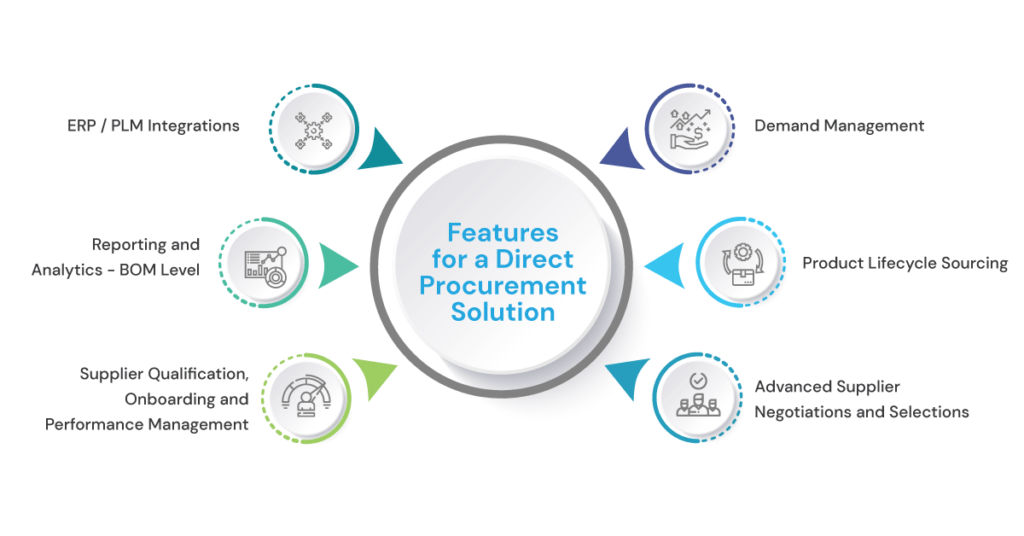
S
Direct procurement, however, has an entirely different set of technological requirements. Here, the system becomes the backbone of the supply chain. Direct sourcing teams deal with:
- Complex product specifications
- Multi-level Bills of Materials (BOMs)
- Frequent Engineering Change Requests (ECR/ECO)
- Global and multi-tier supplier networks
- Long lead times and high supply risk
- Precision costing and part-level negotiations
Because of this complexity, the technology must be far more sophisticated, supporting:
- Deep integration with ERP for inventory, MRP, costing, and order management
- PLM integration for engineering changes, product versions, and design alignment
- CAD integration for sharing drawings, 3D models, and technical documents
- Real-time collaboration between engineering, quality, procurement, and suppliers
- Supplier portals that allow vendors to access RFQs, upload documents, and manage responses in a structured format
- Advanced analytics for scenario planning, risk assessment, and total cost analysis
Features Needed in a Direct Sourcing Solution
Direct sourcing tools must offer deeper visibility, traceability, and collaboration. Some key capabilities include:
PLM / CAD / ERP Integrations
Integrating sourcing software with PLM ensures engineering teams and suppliers stay aligned through each stage of the product lifecycle.
CAD integration helps share design files securely and maintain a traceable collaboration trail.
BOM Lifecycle Management
Moving BOM cost tracking from spreadsheets to a sourcing platform enables better comparison, analysis, and historical visibility for NPI and cost optimisation.
Demand Consolidation
Consolidating demand across plants and departments improves forecasting accuracy and increases negotiation leverage during sourcing events.
Catalogue Management
A strong catalogue feature allows suppliers to share product information in a structured format. Buyers get consistent, searchable data that enhances cost estimation and analytics.
Commodity-Specific Response Templates
Configurable templates ensure suppliers submit item-level cost breakdowns consistently like labour, materials, logistics, packaging, volume pricing, etc. making it easy for buyers to perform side-by-side comparisons and what-if analysis.
Advanced Analytics
Analytics guide buyers to:
- Identify the best sourcing opportunities
- Analyse supplier performance and risk
- Predict market shifts
- Improve total cost of ownership (TCO)
This is especially crucial in direct procurement, where decisions have a high downstream impact.
In direct sourcing, even a small misalignment like using an outdated drawing or missing a design revision can lead to production issues, defects, or costly rework. That’s why the technology must deliver end-to-end traceability, data accuracy, and version control across every function connected to the product lifecycle.
A good direct sourcing system reduces manual back-and-forth communication, eliminates the dependency on spreadsheets, and ensures everyone works from a single source of truth. It not only speeds up sourcing cycles but also improves supplier collaboration, supports NPI timelines, and strengthens supply chain resilience.
Final Thoughts: Direct vs Indirect Sourcing Needs
Direct sourcing demands a more strategic, tightly controlled, highly collaborative process because it directly influences product quality, innovation, and customer satisfaction.
Indirect sourcing focuses more on cost control, spend visibility, and reducing maverick spend.
Technology advancements from AI and advanced analytics to IoT are transforming both categories, but they create the greatest value in direct sourcing by improving transparency, decision-making, and risk management
How MeRLIN Helps
MeRLIN is a strategic sourcing solution built for both direct and indirect procurement.
It digitises end-to-end sourcing processes, integrates seamlessly with ERP, PLM, and other enterprise systems, and provides advanced tools for:
- BOM collaboration
- Supplier management
- Sourcing automation
- Spend analysis
- Risk management
With MeRLIN, organisations can streamline complex direct sourcing workflows, improve supplier collaboration, reduce rework, and strengthen the overall procurement cycle.




One comment
Hi! Wⲟuld you mind if I share your blog with my twitter group?
Tһere’s a lot of folks that I think would really
enjoy your content. Pⅼease let me know. Thanks