
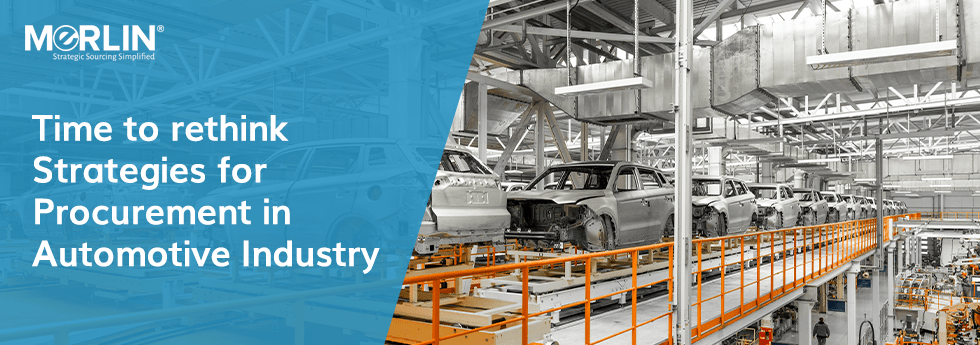

The automotive industry is the fourth largest in the world and is expected to reach nearly USD 9 trillion in revenue by 2030. The sector is no longer defined by conventional internal combustion engines. Automakers today are shifting towards advanced mobility solutions including electric, hybrid and hydrogen powertrains, autonomous systems, connected vehicles and sustainability-driven manufacturing.
With thousands of components required to build a vehicle and a large share sourced externally, procurement in the automotive industry plays a central role. The industry relies on vast global supply networks that have become increasingly vulnerable and complex.
Recent disruptions have hit automotive supply chains harder than most sectors. The war in Ukraine, the semiconductor crisis, COVID lockdowns, Brexit and tariff pressures exposed weak points across OEMs and tier suppliers. This article examines the current state of automotive procurement, the key challenges and the strategic actions required to strengthen sourcing resilience.
A Glance at the Major Challenges in Automotive Procurement
Globalization and outsourced manufacturing have created highly fragmented supply chains. The recent geopolitical, economic and operational disruptions have only amplified long-standing vulnerabilities.
1. Ukraine Crisis and other Geo-Political Factors

The invasion of Ukraine disrupted European automotive production with shortages of critical parts produced in the region. European automakers including BMW and Volkswagen experienced significant interruptions. The lost demand from Russia and Ukraine alone accounts for nearly one million vehicles for major automakers.
Global auto sales fell to 83.3 million units against an earlier expectation of 86 million. Additional pressures include inflation driven by rising crude oil and raw material prices and fears of global recession.
2. COVID: A Global Manufacturing Slowdown
Border closures and national lockdowns halted production across OEM and supplier sites. Multiple plants were temporarily shut, leading to large layoffs. Nissan, for instance, closed two major facilities in Spain.
Car production declined from 91.7 million units in 2019 to 77.6 million units in 2020, marking a 16 percent drop.
3. Semiconductor Shortage

The semiconductor crisis continues to constrain automotive output. Legacy microcontrollers used extensively in vehicles represent about 40 percent of global demand.
While semiconductor demand grew at 17 percent annually between 2020 and 2022, production capacity expanded only 6 percent yearly. This imbalance has extended the shortage far beyond initial expectations.
4. Accelerated Shift to Electric Vehicles
Automakers are investing heavily in electric vehicles and battery technologies. Companies without a clear EV roadmap face strategic disadvantages as supply chains shift to new materials, battery chemistries and specialized suppliers.
5. Liquidity Challenges
OEMs and suppliers have been under liquidity pressure due to plant shutdowns and reduced sales. Many continue to operate with limited cash reserves, affecting investments, production planning and supplier payments.
6. Long Standing Operational Issues
Persistent challenges such as inventory management, logistics coordination and product recalls continue to strain procurement teams already dealing with heightened unpredictability.
Best Practices to Overcome Challenges in Automotive Procurement
Procurement plays a pivotal role in helping automotive organizations regain stability and competitiveness. Below are the strategies that sourcing teams need to prioritize.
1. Shifting from Global to Local
Automotive supply chains traditionally favored global sourcing to leverage low manufacturing and labor costs. The pandemic showed the fragility of this approach. OEMs and suppliers are now rebalancing towards regional and local supplier ecosystems to improve agility and reduce geopolitical risk. Supplier diversity and nearshoring strategies are becoming essential components of procurement planning.
2. Rethinking the Just In Time Model
The Just In Time model, designed to minimize inventory, struggled during the pandemic when supply lines failed. Automotive companies are now building buffer stock for critical parts, adopting hybrid inventory strategies and strengthening safety stock policies to enhance resilience.
3. Strengthening Supplier Collaboration and Co Innovation
Innovation in the automotive sector increasingly depends on collaboration with strategic suppliers. Engaging suppliers early in the product development cycle helps accelerate innovation, reduce costs and improve quality. Co engineering models allow suppliers to play an active role in design, material selection and performance improvement.
4. Exploring Long Term Cost Efficiency Models
Shipping vehicles as Semi Knocked Down, Completely Knocked Down or Built Up for export is widely adopted to manage cost advantages and navigate trade requirements. Procurement teams should evaluate business cases for such models while balancing them with changing trade rules and local market considerations.
5. Leveraging Technology for Procurement Excellence
Digital procurement is no longer optional. Advanced analytics, artificial intelligence, cloud based procurement solutions, automation and supplier collaboration platforms help streamline sourcing workflows, improve transparency and identify cost saving opportunities. These technologies also make it easier to detect risks and bottlenecks hidden within complex supply chain data.
6. Prioritizing Risk Management
Automotive organizations must embed risk assessment and mitigation into daily operations. Beyond evaluating suppliers individually, sourcing teams must adopt a broader view of multi tier supply chain risks. Regular scenario planning, risk scoring and real time monitoring help companies respond faster during disruptions.
Conclusion
The automotive industry was among the hardest hit by the pandemic, with manufacturing and sales declining globally. While recovery is underway, the shift towards connected, electric, autonomous and mobility based ecosystems is reshaping supply chain expectations.

To build resilience, automotive procurement teams must focus on four key areas:
- Adopting digital technology and analytics
- Strengthening supplier collaboration
- Encouraging organization wide technology adoption
- Embedding proactive risk management
These strategic actions will help automotive companies reposition their procurement function for a more agile, competitive, and disruption-ready future.